
Paradise Aliens (2025)
Acrylic over Heavy Weight Paper
Exhibited at Northwestern University’s Wirtz Center Chicago
Curated by Jorge Silva and commissioned by Pivot Arts


Paradise Aliens is a series of monumental paintings by Alonso Galue that traverse the entangled terrains of migration, climate crisis, and post-colonial mythology. Rendered in thick, visceral layers of acrylic, these works conjure a mytho-poetic world in which the boundaries between the ancestral and the futuristic, the sacred and the absurd, collapse into one another.
Inspired by Latin American visual syncretism, particularly the religious and folkloric traditions encoded in masks and ceremonial objects. Galue constructs fractured landscapes inhabited by surveilled humans, frustrated deities, muddy rainbows, and drones mistaken for birds. Each painting serves as a psychic cartography of displacement and transformation, where the familiar and the foreign merge in unsettling yet luminous ways.
These are not static mythologies but fluid allegories: Chicago’s Blue Line train might pass through a fever dream version of Canaima; an iguana imagines itself a chameleon; and the ancient Andean prophecy of the Condor and the Eagle uniting is reimagined as an atomic ballet , set in motion when oil is extracted from a sacred lake.
At the heart of the series is a cosmology of crisis and resistance. In Galue’s vision, the primordial laugh that once set the universe in motion still echoes in today’s fractured world - reminding us of our cosmic smallness while confronting us with our environmental and spiritual responsibilities.
Paradise Aliens is not just a narrative of loss. It is an invitation to see the post-colonial body - human, animal, divine, and territorial - as a contested site of memory and prophecy. Galue’s work suggests that in the ruins of exploitation and globalization, there still exists the possibility of myth, laughter, and radical reimagining
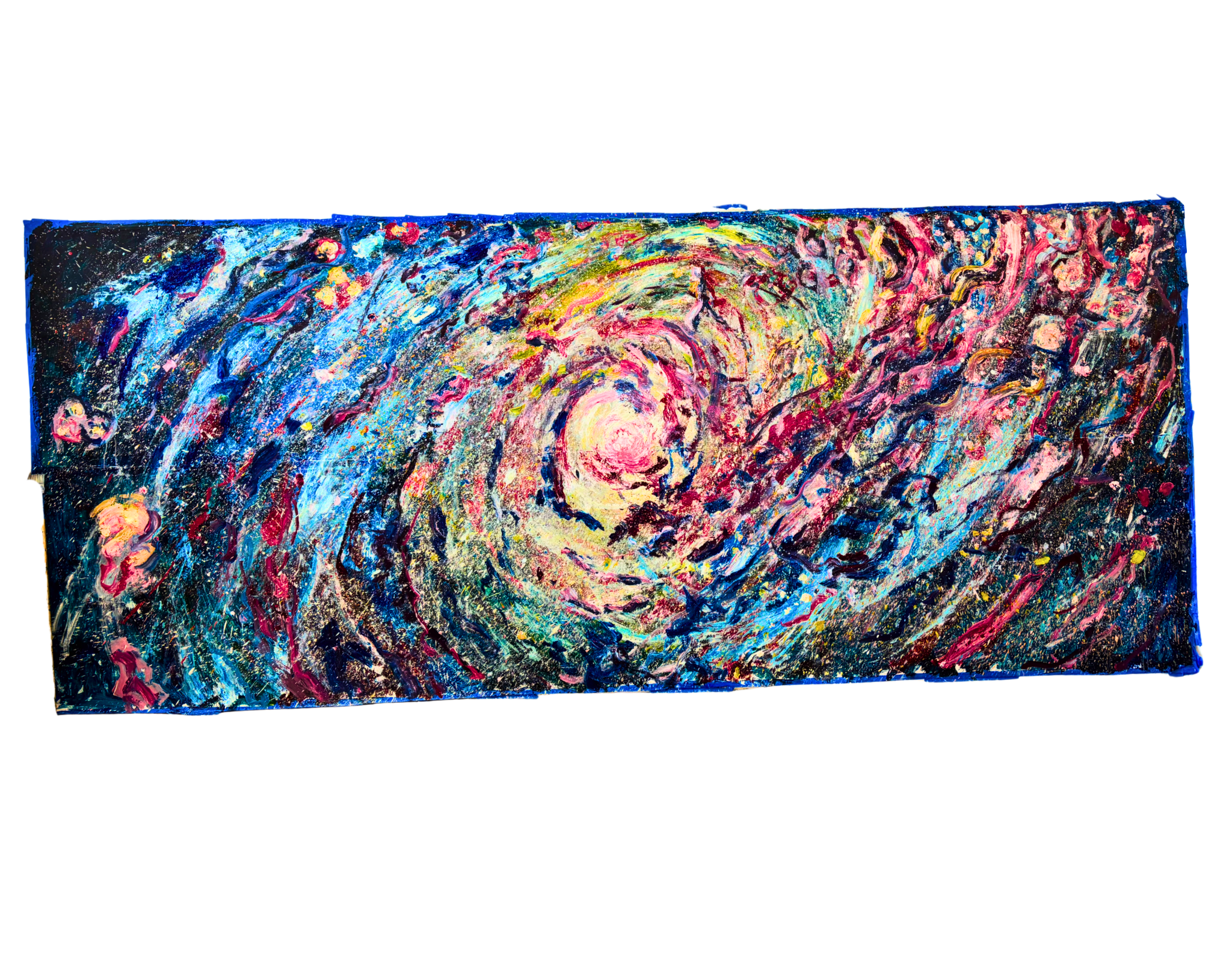
La Risa Primordial ⏐ The Primordial Laughter (2025)
In the beginning was chaos.
In the beginning was the all, a resplendent mass of formless matter, without beginning or end, only a primal chaos in continuous motion centered yet centrifugal at once.
The primordial emerged from uniting and separating, from centering and dispersing, within a great laughter arisen from the oracles of the before-beginning. The formless matter of the universe consolidated as the mother of all, unfolding in its full force. From there came the great whirlwind of energies that mingled without distinction, never foreseeing the complexity of the terrestrial globe.
La Risa Primordial ⏐ The Primordial Laughter (2025) by Alonso Galue explores the origin within a pictorial, hallucinatory, convulsive mass that expresses the energies and the force of the mother of all. That which, in the beginning, gazed upon nascent humanity with a mocking laughter—for it knew, through the oracles, what suffering would attend the consolidation of its matter into life and its intricate existence.
In the Muisca tradition of Chiminigagua, the universal energy force gives birth to a group of birds that form the universe through their mythic dance. This piece was created by dancing, so that the strokes were directed from the consciousness of the relationship between humans and nature itself.
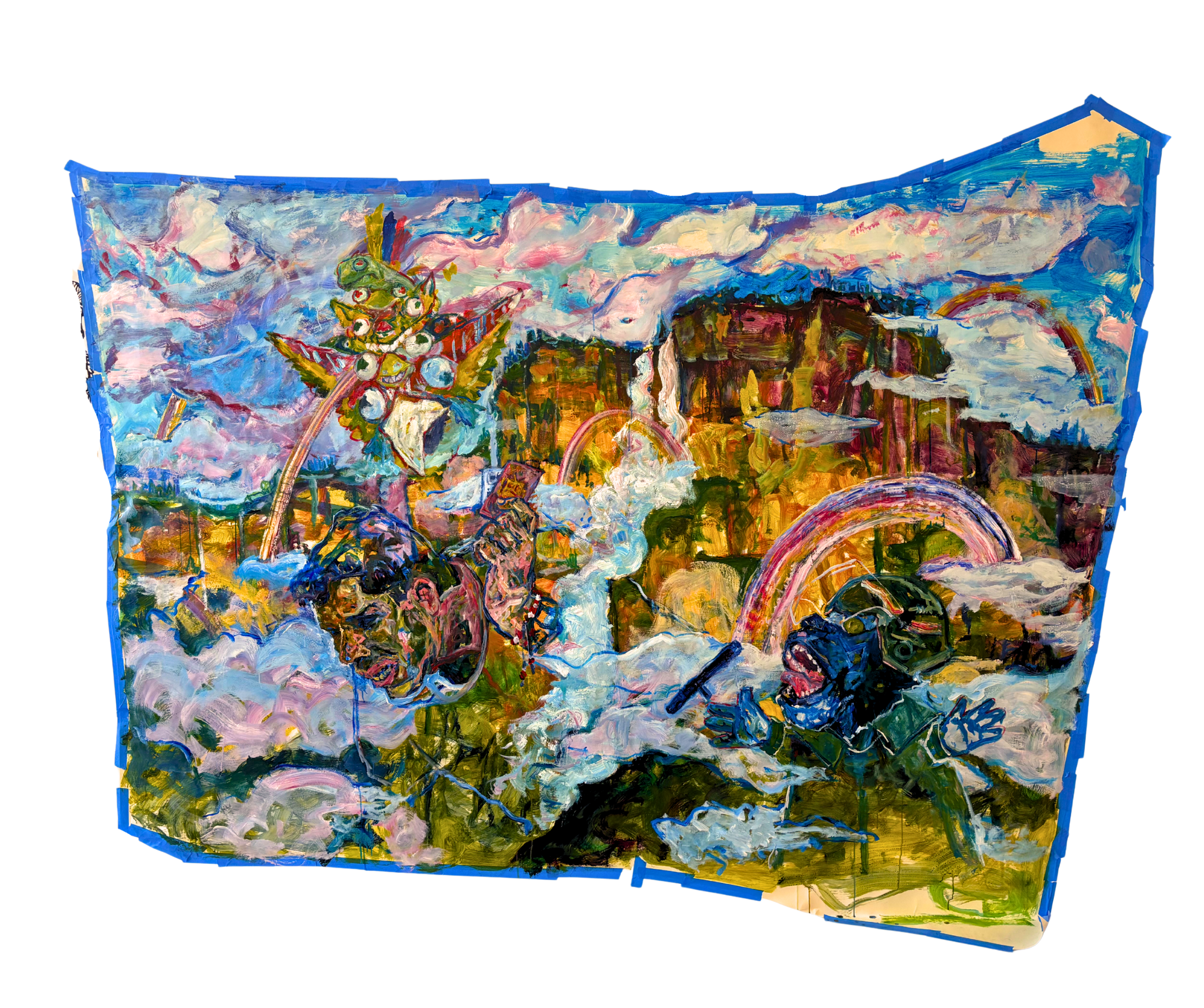
The Gorilla, the Macaw, and the Venezuelan | El gorila, la guacamaya y el venezolano (2025)
The triad of the gorilla, the macaw, and the Venezuelan, constructed atop the imposing landscape of Angel Falls, unknown to a large portion of Venezuelans, expresses in its plastic space a metaphor of the natural world as a territoriality known only by hearsay or glimpses, but rarely truly lived. At the same time, it serves as a powerful metaphor for the color, the humanity, simbols and emotions that currently defines us.
Each character in The Gorilla, the Macaw, and the Venezuelan (2025) is part of our strange everyday reality. A gorilla that we fear, without any kind of political correctness, as it represents, in common slang, strength, domination, and the brutality of power. On the other hand, the macaw, which divides in its corporeality until it reaches that iguana it carries upon itself, adorned with the Venezuelan tricolor, and which symbolizes, for many, the preservation of our freedom in a tropical country where the exoticism and exuberance of what is ours overflows without limit. And finally, the Venezuelan shows his resistance in the memory of what has been lived and what is known. The Venezuelan is a signifying transit, in motion, for at this moment, like other migrants, he belongs neither to the sky nor to the underworld. He, this forced migrant, now walks among ruins and memories, taming his nostalgia.
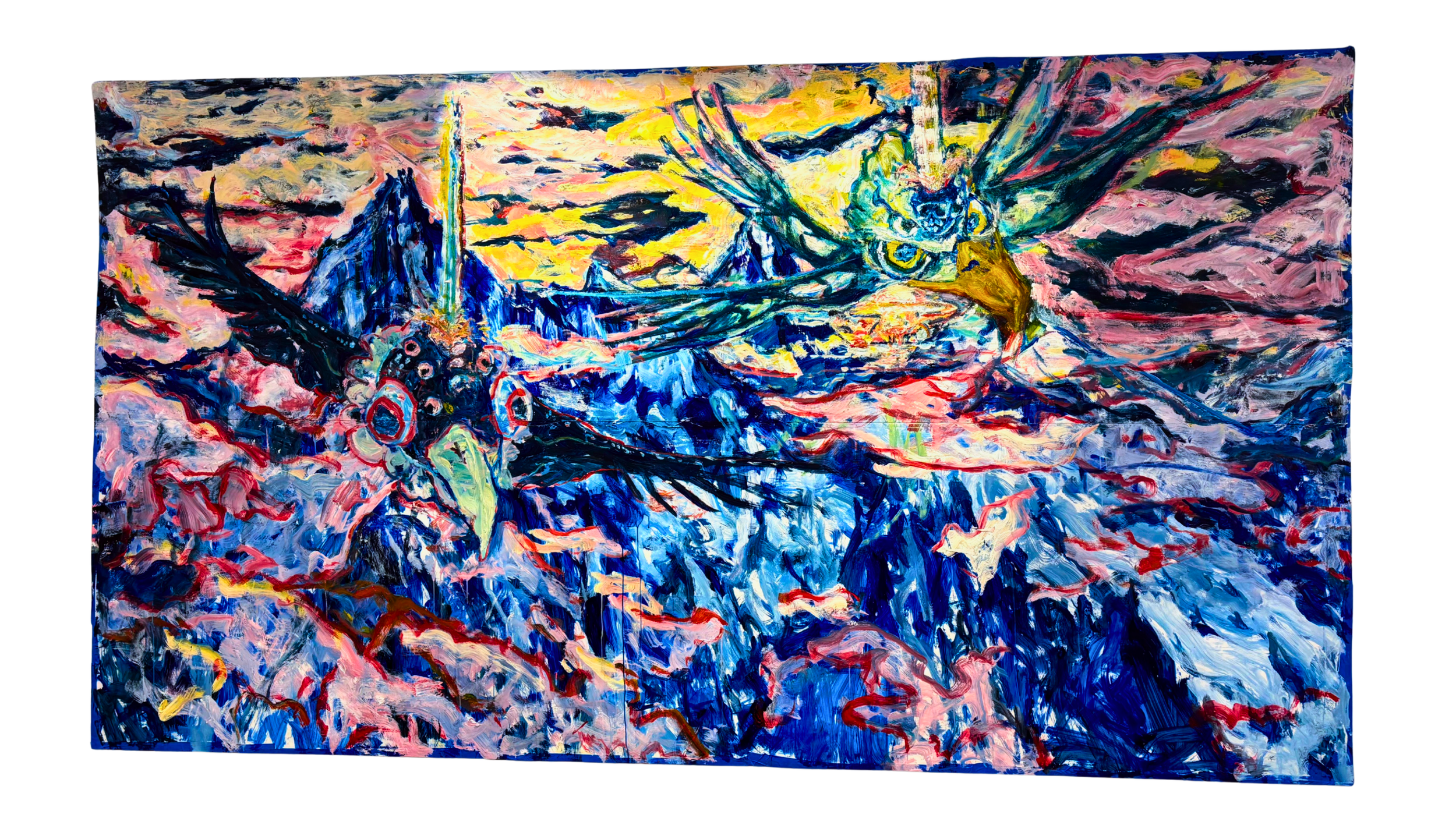
Alonso Galue Dance of the Condor and the Nuclear Eagle | Danza del Cóndor y el Águila Nuclear 2025 89.96 x 142 inches
The apparent global realities mobilized amid the local and the global, between prosperous and precarious economies, between the unexpected displacements of populations and the ongoing exploitation of the other's non-renewable energies. Norths and Souths that shape new - or not so new - forms of observation and definition of one another, of the ancestral and the technological.
Dance of the Condor and the Nuclear Eagle (2025) leads us through a geography charged with telluric energy, with unexpected colors in their arbitrariness, in which two birds laden with meaning by the territoriality to which they belong meet in the same place, in a synchronized flight within the powerful expression with which they are presented to us.
The condor, which soars over the Andean landscapes of the southern part of the American continent and represents - in the symbolism of the South -spiritual elevation , memory, and continuity; beside it an eagle, but not just any eagle: this one is defined by the word nuclear, emblem of the threatening energetic intervention, of the forces of surveillance, of the precision of armed invention, and of power.
Nevertheless, both birds fly within the symbolic choreography created by Galue, in which they represent ancestral knowledge and technological dominance, and both meet in the same convulsive sky, transcending any border.

We Were All Heroes, and What Now? | Todos Fuimos Héroes, y Ahora Qué? 2025
An undetermined number of Venezuelans have emigrated from the country over the last 15 years, for predominantly political and economic reasons. Families have been divided and fractured following a long process of civil struggles, misunderstood and worn down by the regime.
A symbol of those struggles was the appropriation by protesting collectives of the uniform of the liberator Simón Bolívar, but rendered on a T-shirt fabric that denoted a contemporary renewal of Venezuelan heroism centered on a predominantly young population.
We Were All Heroes, and What Now? (2025) poses a great open question about the transience of that collective heroism. Struggles that now evoke and remind us of the moments when the epic was part of each one of our everyday lives. A T-shirt that transmitted the hero to us - that subject we could become in the instant of struggle, in resistance or in the fervor that united many under a cause, a gesture, or an urgency.
The Iguana Hero shows his Green Card to the bird-drone in a hallucinatory Canaima that is a stopover by broken dreams and the Blue Line in Chicago.
Today, in that suspended “now,” memory is interrogated: What remains of the heroic impulse? Has it been transformed, diluted, silenced, or has it departed?
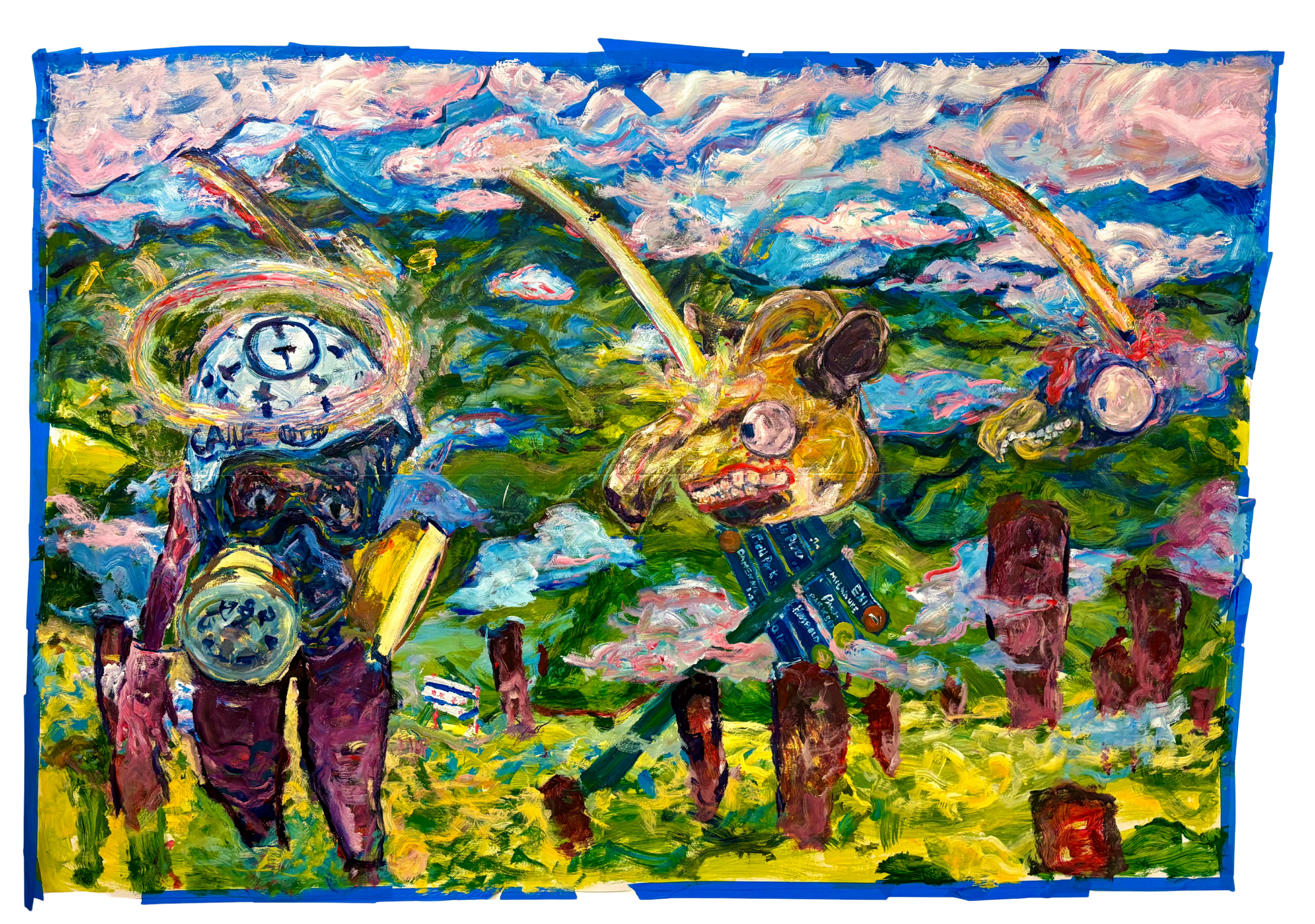
Andean Cemetery on the 606 / The Tapir and the Condor Weep with the Holy Protester | Cementerio andino en el 606 / El tapir y el cóndor lloran con el santo guarimbero 2025
96 x 142 inches
Appropriating the place one arrives at, amid migration, builds new spaces of memory and pathways for recollections. The cemetery is the final place, the site of tears and of individual and collective memories. There we gather and console one another.
Symbolically constructing an Andean cemetery on the 606 (Chicago) is to revalue an abandoned memory with the intention of transforming it into a vibrant place of new active signifiers. In this hallucinatory landscape, the cemetery pulses in the artist's characteristic chromatic palette, inhabited by real characters from his memories.
A tapir, a condor, and a headless figure whose head is attached to a trunk. Each of these characters carries its own significance within Venezuelan identity, and they are deterritorialized by the artist to establish a language of remembrance in what is defined as this Andean cemetery.
These particular characters are part of Venezuelan mythology hybridized between the European, the Indigenous, and the African. The tapir symbolizes the mythical animal of the humid jungles and mountainous forests. It is the icon of solitude and introspection, of retreat, reflection, and connection with the inner world.
The condor, in turn, represents the ancestral, the sidereal bird, but the character with the head on its trunk is a re-dimensioning of a colonial image- of the headless men - in which Galue pays homage to those fallen in the Venezuelan civil battles waged against the current regime. Those we lost and who were seen as "others" by those in power.
Andean Cemetery on the 606 / The Tapir and the Condor Weep with the Holy Protester (2025) is the place of memory, a memory symbolized in a space appropriated for that purpose.
A place - the artist's place - where memory and resilience unite as silent witnesses to the weeping of Venezuelan society that persists on the margins and among those who have left.
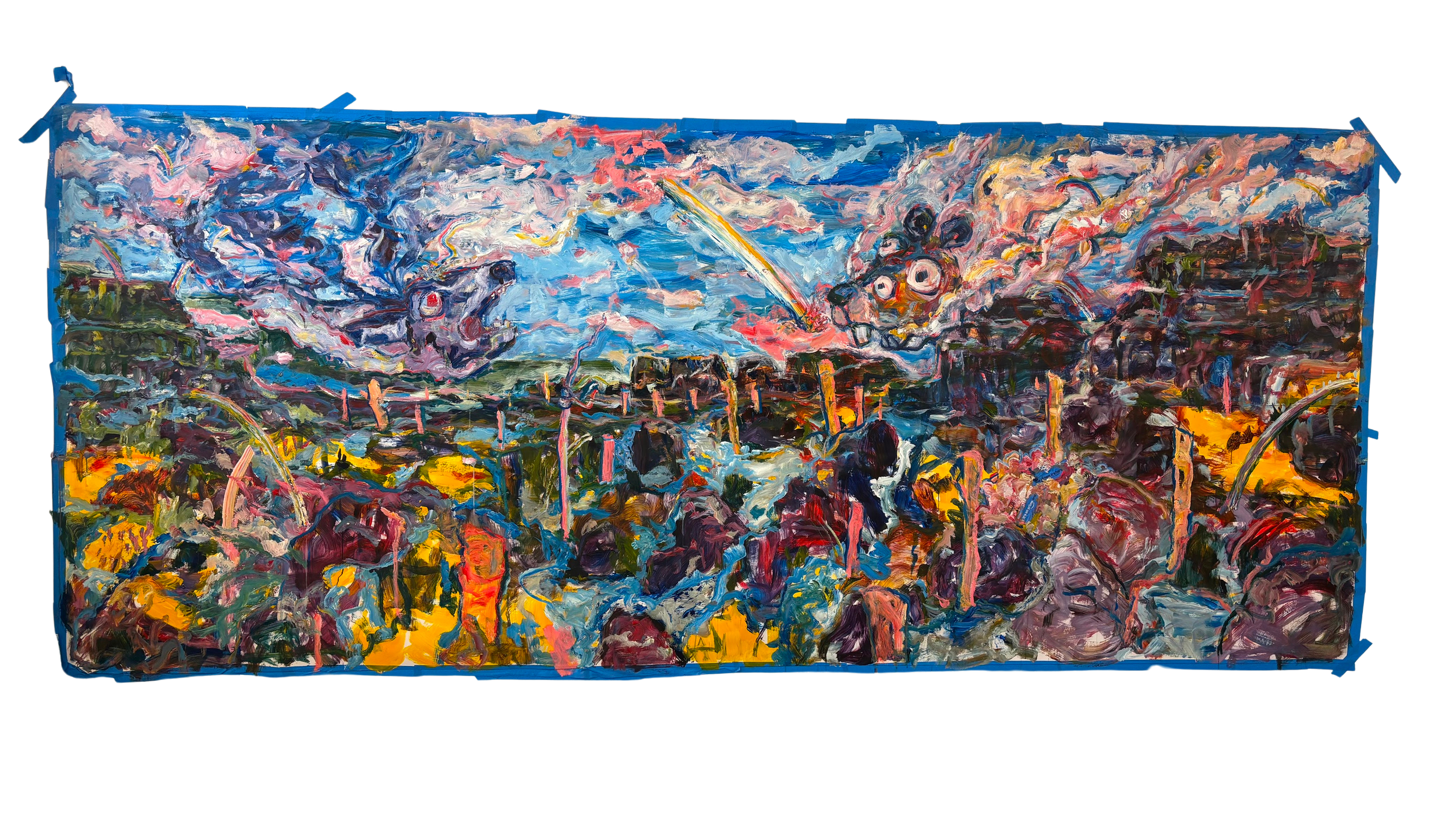
It's on Prime and now here — the sad tale of the smoking beaver and the whale-deer in Roraima (2025)
Invented fables or mythologies spring forth in the artist's pictorial field, in a place that seems suspended in another time: Roraima, the sacred tepuy for the Pemón, "house of the gods" (tepui = place where spirits/divinities dwell), the stump of the cosmic Tree of Life felled in their ancestral myths, origin of creations, floods, and the lost abundance. Here, a smoking beaver and a whale-deer emerge as impossible, unreal yet profoundly symbolic creatures, hybrids born from dreams, mental arbitrariness, and the urgent need to unite the continental knowledge in order to give birth to something new.
In this contemporary fable, these two entities take part in a silent catastrophe: the damage inflicted on the jungle ecosystems by unchecked mining exploitation, climate change, and global overconsumption. The Canadian smoking beaver exhales soot and burned memory, embodying the forest fires that devour the land; the whale-deer, a fusion of marine strength and terrestrial fragility, represents what resists swimming against the current, trembling upon hearing it.
This story circulates on Amazon, symbol of the global market and consumption with awareness, and now it arrives here: Roraima as a stage for passage, mourning, and revelation. A tepuy that listens but does not respond to human onslaught, mirroring all the broken geographies of the world order.
Pemón origin stories see the tepuyes as remnants of the Tree of Life granted to their ancestors upon arriving in the Amazonia; today, this space transforms into a symbolic battlefield for new deities: the smoking beaver as devastating fire, the whale-deer as instability between sea and land in a post-apocalyptic universe forged from exile.
The place becomes a reminder and a sacred place: sticks marking the graves of environmentalists and protectors, echoes of resistance that persist in the ruins of this ancient deities mutated by toxicity.